
 English
Sending SMS to Equatorial Guinea
Equatorial Guinea uses +240 and is the only sovereign African state with Spanish as an official language — Latin script, so ñ and accented vowels are the only characters costing extra. The country is split between a mainland region and the island holding its capital.
How your name appears in Equatorial Guinea
General guidance — we have not yet confirmed Equatorial Guinea-specific sender ID rules.
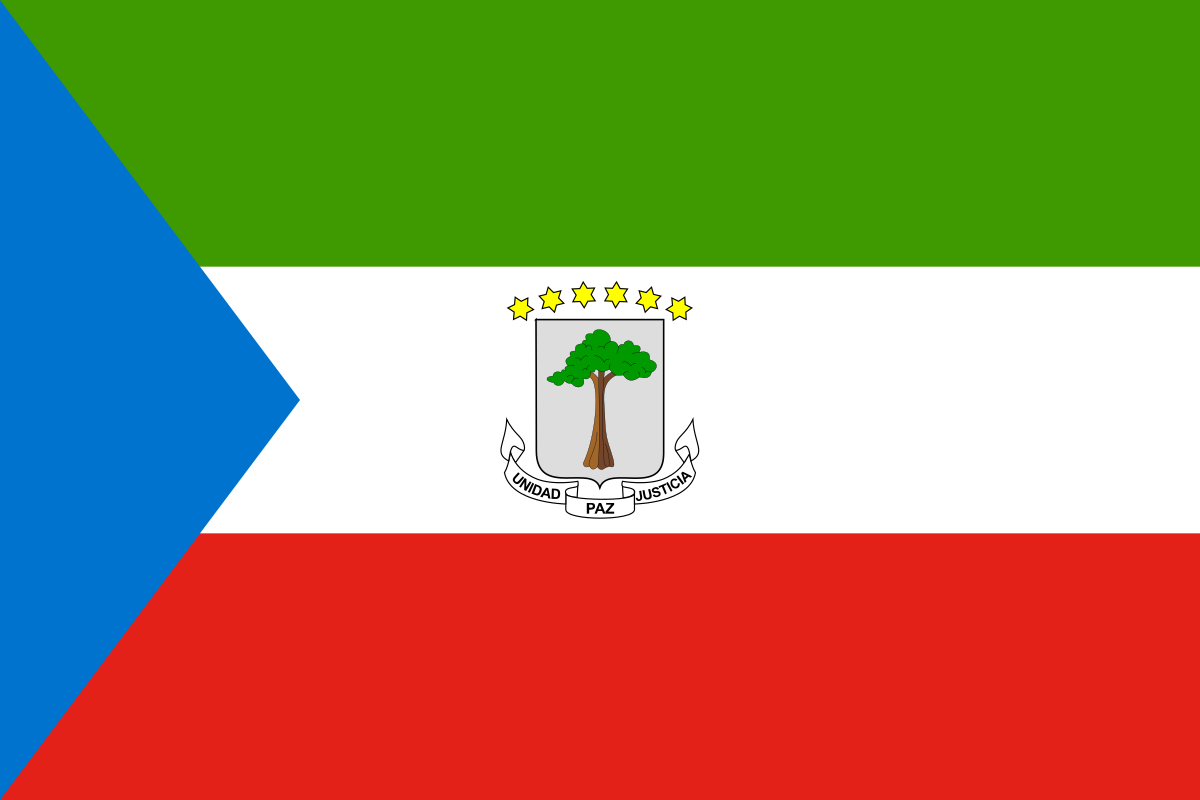 Delivered on +240
Sender ID rules for +240
Both alphanumeric and numeric sender IDs are supported where the local network allows it. Exact registration steps, character limits and lead time vary by operator, and are confirmed as part of onboarding before your first send.
What people send most: OTP and account verification · Order and delivery updates · Appointment and service reminders.
Message length: under the standard SMS encoding, a segment typically holds 160 GSM-7 characters, or 70 once a message uses Unicode — Arabic, Chinese, Cyrillic, emoji. Longer messages split into several segments automatically and are billed per segment; exact limits are confirmed for Equatorial Guinea as part of onboarding.
What Equatorial Guinea requires
General practice for reaching Equatorial Guinea — market-specific requirements are confirmed with you before your first send.
Requirement 1 of 4: Get clear consent before sending marketing messages, and keep a record of it.
Get clear consent before sending marketing messages, and keep a record of it.
Checked automatically on every message we send to Equatorial Guinea — nothing for you to track by hand.
Mobile operators in Equatorial Guinea
Named operators for Equatorial Guinea have not been confirmed yet — routing still reaches every licensed network in the market.
Full network coverage
Routes provision automatically to every licensed operator serving Equatorial Guinea — no operator list for you to maintain.
One route per message
Each send is evaluated in real time and placed on the best-performing path available at that moment.
Delivery reporting either way
Per-message delivery status, the same whether an operator is named on this page or not.
Common SMS use cases in Equatorial Guinea
Time-critical — it has to land in seconds, which is the reason SMS still wins here over push or email.
Keeps the recipient's attention without needing an app open, for the moment they actually care about the update.
Cuts no-shows more effectively than email — most people notice a text within minutes of it arriving.
How to dial Equatorial Guinea
Every part of the number, laid out separately, then the same thing written the way an API expects it.
+240 — +240 followed by the national number
From abroad, replace your exit code with +, then 240, then the national number — dropping the national trunk prefix if the country uses one (a leading 0 in most, though not in the +1 numbering plan). Store numbers in E.164 (+240…) and they work from any country and any API.
Equatorial Guinea by the numbers
The figures below come from public country data and set the context for how much SMS traffic Equatorial Guinea actually carries.
All country calling codes
Looking for a different country? Pick a continent, or search by name, code or ISO — no need to go back to the directory page.
 AlgeriaDZ+213
 AngolaAO+244
 BeninBJ+229
 BotswanaBW+267
 Burkina FasoBF+226
 BurundiBI+257
 CameroonCM+237
 Cape VerdeCV+238
 Central African RepublicCF+236
 ChadTD+235
 ComorosKM+269
 DjiboutiDJ+253
 DR CongoCD+243
 EgyptEG+20Equatorial GuineaGQ+240
 EritreaER+291
 EswatiniSZ+268
 EthiopiaET+251
 GabonGA+241
 GambiaGM+220
 GhanaGH+233
 GuineaGN+224
 Guinea-BissauGW+245
 Ivory CoastCI+225
 KenyaKE+254
 LesothoLS+266
 LiberiaLR+231
 LibyaLY+218
 MadagascarMG+261
 MalawiMW+265
 MaliML+223
 MauritaniaMR+222
 MauritiusMU+230
 MoroccoMA+212
 MozambiqueMZ+258
 NamibiaNA+264
 NigerNE+227
 NigeriaNG+234
 Republic of the CongoCG+242
 RwandaRW+250
 São Tomé and PríncipeST+239
 SenegalSN+221
 SeychellesSC+248
 Sierra LeoneSL+232
 SomaliaSO+252
 South AfricaZA+27
 South SudanSS+211
 SudanSD+249
 TanzaniaTZ+255
 TogoTG+228
 TunisiaTN+216
 UgandaUG+256
 ZambiaZM+260
 ZimbabweZW+263
Other country codes
Countries with neighbouring dialling codes.
Start sending to Equatorial Guinea
Direct routes, per-operator delivery reporting and sender ID handling for +240 — from one dashboard or one API call.